


.svg)
68% of CFOs say they have been slow to adopt AI because they do not know where to start.
That figure, from CFO Connect's State of AI in Finance 2026, is worth sitting with for a moment. The CFO is the person in the organisation best equipped to evaluate ROI, model risk, and phase investment. These are exactly the capabilities that an AI roadmap requires. And yet more than two thirds of them feel stuck at the starting line.
The problem is not capability. It is framing.
Most finance leaders approach AI as a technology question: which tools should we evaluate, which vendor should we shortlist, which pilot should we run? That framing puts the decision in the wrong hands, generates vendor-driven priorities, and produces the pilots that most teams are stuck in.
The right framing is a transformation question: which finance processes are consuming the most resource for the least value, what would change if we automated them, and how do we sequence that change to build compounding capability rather than isolated projects?
GHJ Advisors put it directly: "AI strategy is not a technology project. It is a financial transformation initiative that aligns data, processes and people behind specific business goals." That distinction is the starting point for a roadmap that works.
The most consistent failure pattern in finance AI adoption is selecting technology before defining the problem. A vendor presents a compelling demo. An internal champion is excited. A pilot is scoped around the vendor's strengths rather than the team's highest-priority needs. The pilot runs. Results look reasonable in the specific context it was designed for. Scaling to production reveals that the technology solves a problem adjacent to the one that actually matters.
Finance still ranks last among all business functions in AI deployment, despite having some of the clearest use cases and the most quantifiable ROI. Part of that ranking reflects the culture of accuracy and auditability that makes finance teams appropriately cautious. But part of it reflects a pattern of starting with the technology and working backward to the problem, which produces exactly the kind of unsatisfying pilot results that justify continued caution.
The correction is simple in principle and genuinely difficult in practice: do the process work before the technology work. Understand what your team actually does, where time goes, where errors occur, and where decisions are being made on incomplete information. Then select technology that addresses those specific points.
Every major technology vendor has an AI roadmap. SAP has one. Microsoft has one. Oracle has one. And they will all present it to you as the path your organisation should follow.
A vendor's roadmap reflects their product priorities, their competitive positioning, and the capabilities that are easiest for them to build and sell. It is not a finance transformation strategy. It is a product strategy.
The CFOs who make the most progress with AI are the ones who develop their own view of what they are trying to achieve before engaging vendors. They go into vendor conversations with specific requirements rather than open questions. They evaluate vendor roadmaps against their own priorities rather than letting vendor priorities define their agenda.
"We are exploring AI" is the answer that most finance teams give when asked about their AI strategy. It is also, in most cases, a description of having no strategy.
Exploration is a legitimate early stage. It becomes a problem when it persists for 12 or 18 months without a decision. 45% of finance teams remain in pilot mode with only 17% using AI in core workflows. The exploration phase is not the cost. The cost is the compounding performance gap that accumulates while exploration continues.
IDC's data is specific: frontier firms in AI adoption achieve 2.84x returns on their investments. Laggards achieve 0.84x. That gap is not primarily a technology difference. It is a timing difference.
A finance AI roadmap that will hold up in practice covers four areas. Most roadmaps that are presented to the board cover only one of them.
Before selecting any technology, map the current state of your finance function with enough specificity to identify where time actually goes. Not where you think it goes. Where it actually goes.
This means following a sample of transactions through the full cycle: an invoice from receipt to payment, a customer payment from remittance to reconciliation, a budget variance from identification to board presentation. Document every step, every system touched, every person involved, every point where the process slows down or requires rework.
The output of this exercise is not a flowchart. It is a prioritised list of where automation investment would have the highest impact, based on volume, cost, and consequence of error. The processes that are highest on that list are the starting points for Horizon 1 of the roadmap.
For most mid-market finance teams, accounts payable leads this list. Invoice processing is high volume, currently manual in most organisations, and errors have direct financial and relationship consequences. It is also the area where AI automation is most mature and most consistently delivers measurable ROI within 90 days.
Every AI system is only as capable as the data it operates on. Before committing to any AI deployment, an honest data readiness assessment covers:
What data exists and where it lives. Financial data is typically fragmented across ERP, banking systems, spreadsheets, and email. AI systems need data to be accessible, structured, and current.
What the data quality actually looks like. Duplicate vendor records, missing fields, inconsistent coding, unapplied payments. These are not unusual. They are the normal state of finance data in most mid-market businesses, and they are the primary source of AI underperformance when addressed after deployment rather than before.
What history is available. AI systems that build behavioural baselines need historical transaction data. Twelve months is a minimum. Twenty-four months allows the system to learn seasonal patterns. Less than twelve months produces baselines that do not yet reflect the full pattern of the business.
The data readiness assessment is not an IT project. It is a finance function project, led by the people who know the data best.
The CFO's 2026 analysis describes the modern finance function as a "Human + Agent collaborative," where AI agents handle data-intensive routine tasks and humans focus on interpretation, scenario evaluation, and strategic business partnering.
That collaborative model requires finance professionals to develop a different set of skills. Not technical skills, primarily. The skill that matters most is knowing what to do with what the AI produces: how to interpret anomaly flags, how to evaluate the outputs of a predictive forecast, how to design the approval logic that an agentic system will execute.
Accenture's Pulse of Change 2026 found that alignment with employees is now the biggest barrier to AI value, and that 43% of workers say clear training in AI tools and workflows significantly boosts their confidence to adopt. The skill investment is not optional. It is the variable that determines whether a technically sound AI deployment produces genuine change in how the team works.
Finance governance and AI governance share a common foundation: clear ownership, documented decision rules, audit trails, and regular review. A finance team that already has strong governance processes in place is starting from a better position than one that is building both simultaneously.
The specific governance requirements for finance AI cover:
The three-horizon framework, adapted from GHJ Advisors' CFO AI roadmap, structures AI investment across time in a way that delivers early results while building toward full-capability deployment.
Horizon 1 is about demonstrating that AI works in your specific environment, building internal confidence, and generating the data and infrastructure that Horizon 2 depends on.
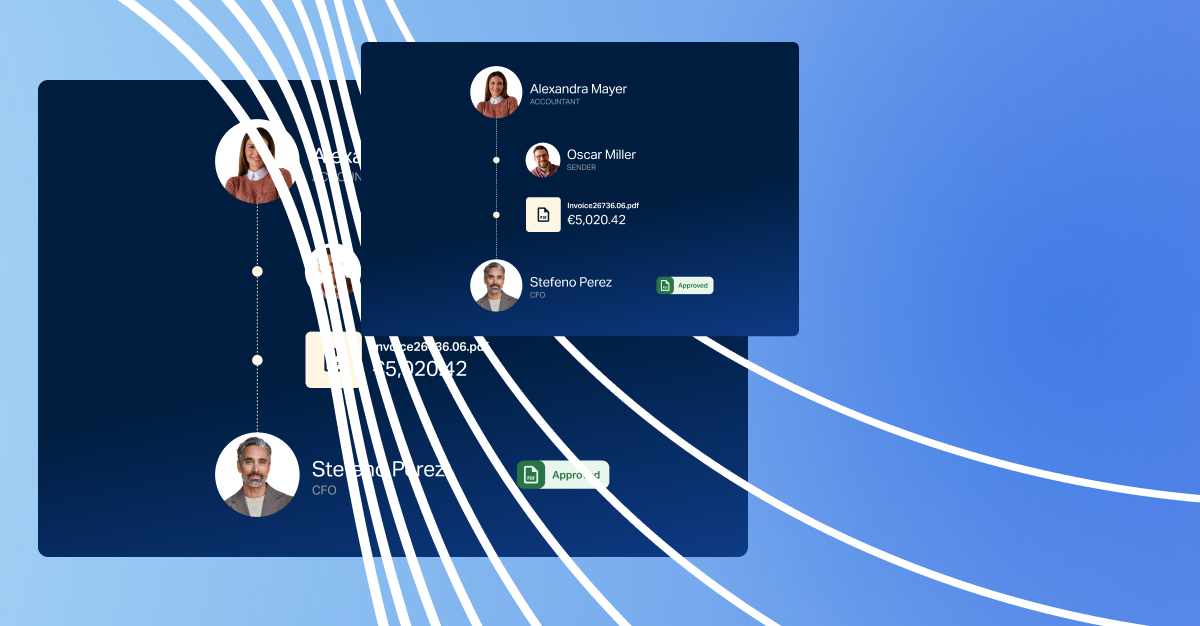
The highest-impact, lowest-risk starting point for most mid-market finance teams is AP automation: invoice capture, three-way matching, and approval workflow automation. The use case is well-defined, the ROI is measurable within 90 days, and the risk of a decision error is bounded by the controls in the approval workflow.
By month six of a well-executed Horizon 1, the typical outcomes are: 70 to 80% of invoices processing without human intervention, a cost per invoice approaching best-in-class levels, and a finance team with meaningfully more capacity than it had at the start of the project.
That capacity is the input to Horizon 2.
Horizon 2 extends automation to the AR cycle and begins connecting AP and AR data into a unified working capital view. It also involves the data quality work that makes Horizon 3 possible: cleaning historical data, standardising vendor and customer records, and ensuring that the data flowing through the automated processes is accurate enough to support predictive analytics.
The close cycle shortens materially in Horizon 2. Reconciliation, which was previously a month-end batch exercise, becomes continuous as the automated systems match payments and invoices in real time. By the end of Horizon 2, the finance function has the data quality and process connectivity that most AI deployments at Horizon 3 level require.
Horizon 3 is where the full value of the earlier investment becomes visible. The data quality built in Horizon 2 supports predictive cash flow forecasting with meaningful accuracy. The process automation built in Horizon 1 and 2 creates the historical transaction data that agentic workflows need to build reliable behavioural baselines.
The finance function at Horizon 3 is operating in the model that The CFO describes for 2026: AI agents handling data preparation, reconciliations, invoice processing, and anomaly detection, while the human finance team focuses on interpretation, scenario evaluation, and strategic business partnering.
That is not a distant aspiration. For teams that start Horizon 1 today, it is an 18 to 36 month operational reality.
If you are the CFO, this section is about how to frame the conversation with your board and CEO. If you are a finance director or controller, it is about how to frame it with your CFO.
The most effective framing is not efficiency. It is risk. A finance function that relies on manual processes for invoice approval, payment reconciliation, and compliance reporting is carrying operational risk that is quantifiable and growing. The Commercial Payments Bill adds regulatory risk to the operational risk already present.
AI automation does not just make the finance function faster. It makes it more controlled, more auditable, and more compliant. Those benefits speak to a board conversation about governance, not just a management conversation about productivity.
86% of C-suite leaders plan to increase AI investments in 2026 and view AI as a growth driver rather than just a cost lever, according to Accenture. The board is not waiting to be convinced. It is waiting for a specific plan from the finance function.
The IT conversation is typically where finance AI roadmaps stall. IT has legitimate concerns about integration complexity, data security, and governance. Those concerns are easier to address when the finance team comes with specific answers rather than vague ambitions.
Specifically: which ERP will the AI system integrate with, and what does that integration look like technically? What data will the AI system access, and what controls limit that access? Who is responsible for maintaining the integration after go-live?
For AI-native platforms with pre-built ERP connectors, like Dost's native integration with SAP, Microsoft Dynamics 365 Business Central, Sage, and Oracle, the answers to most of these questions are already defined. The IT conversation moves from "is this possible" to "how do we schedule the setup."
The finance team conversation is the one most likely to be deferred until after the technology decision. It should not be.
CFO Connect's research identifies insufficient training in AI tools and workflows as one of the four main barriers to AI adoption in finance. The training gap is not primarily about technical skills. It is about understanding how the new way of working feels different from the current way, and why the difference is positive rather than threatening.
The most important thing to communicate to the finance team is not what the AI will do. It is what the team will do instead. When the agent handles invoice processing, the AP team handles exception investigation, supplier relationship management, and process improvement. Those are better uses of their expertise. Making that concrete, with specific examples from the current workflow, is what converts sceptical professionals into engaged adopters.
Leading indicators give early signal before the financial impact is fully visible:
The metric most CFOs do not track but should is how the time freed by automation is being deployed. A finance team that has automated 80% of invoice processing but has not changed what the team does with the recovered capacity has delivered a cost reduction, not a transformation.
The transformation metric is the proportion of finance team time spent on analysis, forecasting, and strategic business partnering versus data entry, reconciliation, and invoice processing. In a pre-automation finance function, the operational tasks dominate. In a post-Horizon 2 finance function, they should not.
The four barriers that CFO Connect identifies are: cumbersome close cycles that leave no time for experimentation, uncertainty about where to start, security and confidentiality concerns, and insufficient training. Three of the four are addressable. One, the close cycle that consumes all available bandwidth, is partly self-referential: automation reduces close cycle pressure, but you need to start somewhere before close pressure reduces.
The practical resolution is to scope a Horizon 1 project that does not depend on the close cycle. AP invoice processing is exactly that. It runs throughout the month, not at month-end. A well-scoped AP automation implementation can run alongside the current process for the first 30 days, with the team validating the agent's output before it runs fully autonomously. By day 60, the agent is handling the volume. By day 90, the ROI is visible.
That is the starting point for the roadmap. Not a strategy document. Not a vendor shortlist. One process, clearly defined, with a 90-day measurement horizon. Everything else builds from there.
Dost's AP and AR platform was designed to be that starting point: native ERP integration from day one, no templates required, intelligent data extraction from the first invoice, and approval workflows configurable by the finance team without IT involvement. The Horizon 1 deployment is measured in weeks, not months.
No. The finance AI roadmap described in this guide is a finance leadership project, not a technology or data science project. The process inventory, data readiness assessment, and skill evaluation are all led by finance professionals with knowledge of the current operation. The technology evaluation involves IT for integration and security questions, but does not require data science capability. For platforms with pre-built ERP connectors and AI-native architecture, the ongoing operation after go-live requires no data science resource. What it requires is finance professionals who understand the process well enough to define the agent's decision boundaries and evaluate its outputs.
The three-horizon framework above covers 0 to 36 months, which is the right planning horizon for a meaningful transformation. But the planning document should not try to specify every decision across that period. Horizon 1 (0 to 6 months) should be specific: which process, which platform, which metrics. Horizon 2 (6 to 18 months) should be directional: AR automation, data quality investment, ERP optimisation. Horizon 3 (18 to 36 months) should be aspirational: agentic workflows, predictive analytics, autonomous finance operations. The specificity at each horizon reflects how much is knowable at the time of planning. Trying to specify Horizon 3 decisions in detail when writing a roadmap today is a planning exercise that will not survive contact with the actual implementation.
The most consistent cause of stalled finance AI roadmaps is the failure to close the gap between the pilot and the production environment. The pilot worked on clean, carefully prepared data in a controlled scope. Production involves messier data, more edge cases, and a team that was not as involved in the pilot design as the pilot team was. The correctives are: involve the production team in the pilot design rather than running the pilot separately, address data quality before go-live rather than treating it as a post-implementation cleanup, and define the production scope precisely before beginning the pilot rather than expanding scope after the pilot succeeds. Roadmaps that take these three steps consistently make the transition from pilot to production. Those that do not consistently stall at exactly that point.
Building an AI roadmap for your finance team does not begin with a technology decision. It begins with an honest assessment of where your finance function spends its time, where the data quality is sufficient to support AI, and how your team needs to develop to operate in a Human + Agent collaborative model.
The CFO is uniquely positioned to lead this. The skills that make an effective CFO, measurement discipline, risk assessment, prioritisation, phased investment, are exactly the skills that an AI transformation requires. The question is not whether finance should be investing in AI. The evidence on that question is settled. The question is whether the investment is driven by the CFO's own view of what the finance function needs, or by vendor priorities and peer pressure.
A roadmap built on the first principle, starting with the process, building toward the data quality, and scaling toward agentic capability, compounds over 36 months into a finance function that operates at a level the current one cannot reach.
The businesses that start that roadmap today are the ones whose competitors will be trying to understand their advantage in three years' time.



.png)