.svg)
79% of finance leaders say their teams are overwhelmed by manual work, according to a 2025 Zuora survey. The processes consuming that capacity are well understood: invoice processing, bank reconciliation, expense management, month-end close, and financial reporting all involve repetitive, rule-based steps that technology is well positioned to handle.
Yet despite that clarity, only 8% of finance departments have fully automated their processes, according to a 2025 Rillion survey of mid-market businesses. Most organisations are running a combination of automated tools and manual workflows, often without a clear picture of which manual steps are most expensive to maintain and which automation would deliver the clearest return.
Accounting process automation is not a single technology decision. It is a series of choices about which processes to automate, in which order, with which tools, and connected to which systems. Getting those choices right determines whether automation delivers measurable ROI or adds a layer of technology on top of the manual processes it was supposed to replace.
Automation in finance and accounting applies across every major workflow, but not equally. Some processes are highly structured and rule-based, making them well suited to automation. Others involve judgement, relationship management, or regulatory interpretation that still require human expertise.
The processes most consistently automated, and most consistently delivering measurable results, are:
Accounts payable and invoice processing: capturing supplier invoices, matching them against purchase orders and delivery notes, routing for approval, and posting to the accounting system. This is where most mid-market finance teams start because the volume is high, the process is well-defined, and the cost of manual handling is straightforward to quantify.
Accounts receivable and collections: generating customer invoices, tracking payment status, sending automated payment reminders on a defined cadence, and escalating overdue accounts through a structured workflow rather than a manual queue.
Bank reconciliation: matching bank transactions against ledger entries automatically, flagging discrepancies for review, and maintaining a continuously current reconciliation rather than a point-in-time exercise at month-end.
Month-end close: automating recurring journal entries, accruals, intercompany reconciliations, and checklist completion so the close process runs on a defined schedule rather than depending on individual team members to remember and execute each step.
Financial reporting: generating standard reports from live data, distributing them to the relevant stakeholders automatically, and flagging variances against budget or prior period without requiring a person to compile the data and run the comparison.
Finance automation can reduce manual work across these processes by 50 to 90%, according to research compiled by Numeric. The range reflects the degree of process standardisation and integration quality: well-standardised processes running on connected systems achieve the higher end. Fragmented processes across disconnected tools achieve far less.
Before automating anything, it is worth being specific about where the manual work actually sits. The finance functions that achieve the clearest ROI from automation consistently start with the same question: which manual steps are consuming the most time per transaction, and which are introducing the most errors?
Manual invoice processing is the most consistently expensive accounting workflow to maintain. At the industry average of $9.87 per invoice (Ardent Partners 2024), a business processing 1,000 invoices per month is spending nearly $120,000 per year on invoice handling alone. Best-in-class automated processing brings that to $2.98 per invoice according to PLANERGY 2025, a 78% cost reduction from the same starting point.
The time cost compounds the financial one. Manual invoice processing takes an average of 10 to 12 days from receipt to payment authorisation. Automated processing consistently brings this below 3 days. For businesses that offer early payment discounts to suppliers, the speed improvement directly affects whether those discounts can be captured.
On the receivables side, manual collections processes suffer from the same coverage problem as manual AP: finance teams can only chase the accounts they have time to reach. Automated collections sequences follow up on every overdue invoice, on a defined schedule, through the appropriate channel, without the AP team having to manage the queue manually.
The coverage improvement directly affects Days Sales Outstanding. Automated AR processes consistently reduce DSO by 8 to 15 days within 90 days of implementation, releasing working capital that was tied up in outstanding receivables that were not being followed up consistently.
Manual bank reconciliation is one of the most time-consuming, least value-adding activities in the finance function. Matching bank statement lines against ledger entries one by one, flagging unmatched items, and investigating timing differences consumes significant hours every month for a result that provides no business insight beyond confirming that the records are consistent.
Automated reconciliation matches transactions continuously rather than periodically, surfaces exceptions in real time, and reduces the month-end close workload that currently compresses the entire close process into a few frantic days. Accounting firms that automate report a 40% reduction in financial close process time, according to Cflow's 2026 workflow automation research.
Generating standard financial reports from manually compiled data is another high-frequency, low-value task that automation handles reliably. When the source data is clean and connected, reports generate automatically on schedule, variance analysis runs against the previous period and budget without manual calculation, and the finance team's time shifts from building reports to interpreting and acting on them.
84% of finance staff report quicker decisions after deploying digital workflows with real-time data, according to Vena Solutions research cited in Cflow's 2026 statistics. The connection between automation and decision quality reflects what changes when the finance team is no longer the bottleneck in getting current data to the people who need it.
The adoption picture in 2026 is one of genuine momentum combined with a significant gap between deployment and measured ROI.
On deployment: 63% of surveyed finance teams said they had fully deployed and were actively using AI solutions, according to the Deloitte Finance Trends 2026 report. AI adoption in accounting firms rose from 9% in 2024 to 41% in 2025, according to Wolters Kluwer, with 35% reporting daily AI use.
On ROI: only 21% of finance teams that have deployed AI report clear and measurable return on investment, according to the same Deloitte report. The gap between 63% deployment and 21% measurable ROI reflects a consistent pattern: organisations add automation tools without redesigning the workflows those tools are supposed to replace. The software runs, but the manual processes run alongside it, and the expected capacity reduction does not materialise.
On readiness: only 8% of organisations describe themselves as very well prepared for AI in finance, according to the AICPA and CIMA Future-Ready Finance survey, despite 88% expecting AI to be the most transformative accounting technology in the next 12 to 24 months.
The pattern suggests that the primary challenge in accounting process automation in 2026 is not technology availability. It is implementation quality and workflow redesign.
Understanding why automation underdelivers for some organisations is as important as understanding what it delivers when implemented correctly.
The most consistent cause of automation underperformance is tools that do not connect to each other or to the core accounting system. An invoice automation platform that does not integrate with the ERP in real time still requires someone to manually transfer approved invoices to the accounting system. An AR automation tool that does not connect to the CRM cannot see whether a customer dispute has been logged elsewhere. The automation handles its specific scope and leaves the handoffs between systems as manual steps.
The fix is integration architecture, not more tools. The accounting processes that automate most successfully are the ones where the data flows automatically between every relevant system throughout the cycle, not at scheduled export points.
Automation applies rules consistently to whatever data it receives. If the vendor master contains duplicate records, the matching logic produces false negatives. If the chart of accounts is inconsistently structured, automated GL coding produces miscoded transactions. If customer records are incomplete, automated AR follow-up reaches the wrong contact.
Automation does not fix data quality problems. It scales them. Organisations that invest in data cleanup before implementation consistently achieve higher automation rates and lower exception rates than those that expect the platform to sort out the data problems it encounters.
The finance team members whose roles change most significantly as automation is implemented are not always the ones who advocated for it. AP staff who have built their workflows around manual invoice checking, approvers who have always signed off in their email inbox, and managers who rely on spreadsheet reports that are no longer maintained need time and support to adapt to the new process.
Automation implementations that treat change management as an afterthought consistently see higher exception rates, lower adoption of the automated approval tools, and more manual workarounds than those that involve the finance team in the workflow design from the start.
The organisations that achieve measurable ROI from accounting automation consistently follow the same sequence.
Start with the highest-volume, most rule-based process. For most mid-market finance teams, this is accounts payable and invoice processing. The process is well-defined, the cost per transaction is easy to calculate, and the improvement from automation is straightforward to measure. Success here builds the credibility and the data to justify extending automation to other workflows.
Connect the automation to the ERP before adding features. Real-time integration with the accounting system is the foundation on which everything else depends. Automation that operates independently of the ERP creates reconciliation work that offsets much of the efficiency gain. Integration first, features second.
Measure the right things before and after. Cost per invoice, processing cycle time, exception rate, and close duration are the metrics that show whether automation is delivering. Measuring user satisfaction or system uptime tells you whether the tool is working. Measuring cost and cycle time tells you whether the process is improving.
Extend to adjacent processes once the foundation is stable. AR automation, bank reconciliation, and month-end close automation all depend on clean data flowing from the AP and ERP processes upstream. Getting the upstream data right makes the adjacent automations significantly easier to implement and more likely to deliver clean results.
Dost's platform covers the accounts payable and accounts receivable processes as a connected system, not as separate tools that need to be reconciled.
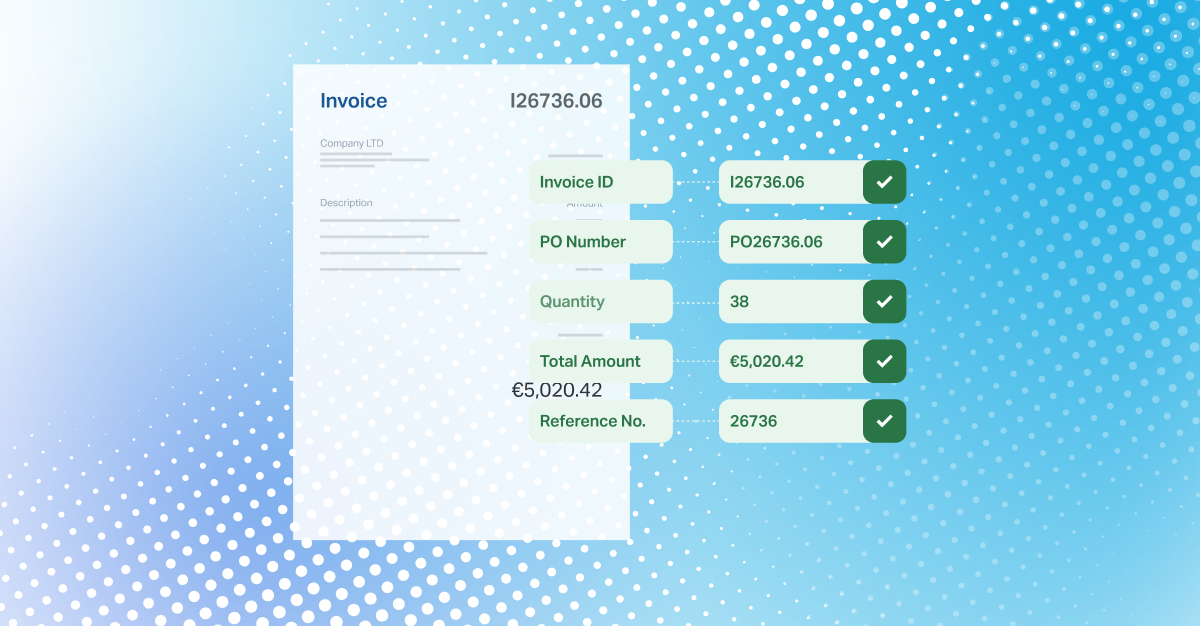
On the AP side, AI-native invoice capture reads any invoice format at line-item level from the first document, three-way matching validates every invoice before it reaches an approver, and the approval workflow routes and escalates automatically with a complete audit trail.
On the AR side, accounts receivable automation handles invoice generation, payment tracking, automated collections sequences, and dispute management, connected to the same real-time ledger view as the AP function.
The connection between AP and AR in a single platform gives the finance team a live view of working capital: what the business owes and what it is owed, updated continuously as invoices are processed on both sides. This is the visibility that cash flow forecasting and strategic payment decisions depend on.
Integration with SAP, SAP Business One, Microsoft Dynamics 365 Business Central, Sage 200, Sage Intacct, Sage X3, and Oracle is bidirectional and real time. The accounting system is always current. The close is a review, not a reconstruction.
Book a demo to see how Dost connects AP and AR automation in a single platform.
Accounts payable and invoice processing consistently deliver the clearest and fastest ROI for mid-market finance teams. The process is high-volume, well-defined, and the cost per transaction is easy to measure before and after. Once AP automation is stable and integrated with the ERP, accounts receivable and bank reconciliation are the next highest-impact areas. Month-end close automation and financial reporting automation deliver significant value but depend on clean data flowing from the upstream processes, so sequencing matters. Starting with AP creates the data foundation that makes every subsequent automation more effective.
The most consistent reasons are integration gaps, data quality problems, and workflow redesign that was not completed. Organisations that add an invoice automation tool without integrating it with the ERP in real time still require manual data transfer at the handoff point. Those that automate on top of a dirty vendor master or inconsistent chart of accounts automate the problems rather than resolving them. And those that deploy the technology without redesigning the approval processes and reporting structures around it find that the team works around the automation rather than through it. The Deloitte Finance Trends 2026 report finding that only 21% of teams with deployed AI show measurable ROI reflects exactly these implementation patterns.
Most organisations implementing AP automation report measurable improvements in processing cycle time and exception rate within the first full month of operation, as the system reaches its configuration baseline and the AP team adapts to the exception-focused workflow. Cost per invoice improvements are typically measurable within the first quarter. DSO reduction from AR automation typically stabilises within 60 to 90 days as the collections sequences build coverage on the full receivables portfolio. Month-end close time reductions are visible from the first close completed with the automated tools in place, typically in the first month after go-live.
Accounting process automation in 2026 is not a single technology decision. It is a series of connected choices about where to start, how to integrate, and how to redesign the workflows that automation is supposed to replace.
The 8% of finance departments that have fully automated and the 79% whose teams are still overwhelmed by manual work are not separated by access to technology. The technology is widely available. They are separated by implementation quality: whether the automation is connected to the accounting system in real time, whether the source data is clean enough for the automation to work on, and whether the finance team's workflows have been redesigned around the automation rather than alongside it.
The starting point that consistently delivers is accounts payable: high volume, well-defined, straightforward to measure, and the data foundation on which AR automation, reconciliation, and close automation all depend.
See how Dost connects AP and AR automation in a single platform. Book a demo.