HOW IT WORKS
The e-invoicing process,
step by step
From creation to archiving, here's how a compliant e-invoice flows, and where Dost handles each stage automatically.


Einvoice
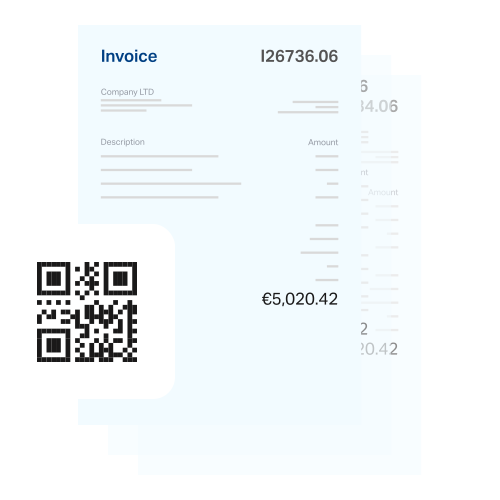
An eInvoice is a digital invoice issued, transmitted and received in a structured data format that both systems can process automatically, no manual intervention. Discover how the e-invoicing process works, the EU regulations behind it, and the benefits for your finance team.










Real numbers, from real customers. Get your time back. Costs down. EBITDA up.
From creation to archiving, here's how a compliant e-invoice flows, and where Dost handles each stage automatically.
Issue in a structured format
The supplier generates the invoice from their e-invoicing software or ERP. With Dost it's issued in the right structured format, Facturae, FatturaPA, UBL or CII, with the electronic signature already applied.
Checked for compliance
The system checks mandatory fields, format and tax compliance. Dost validates against each country's rules and returns an instant compliance status before the invoice ever leaves your system.
Sent through a secure network
The invoice travels through a secure e-invoice network or Peppol. Dost communicates with each tax authority in real time, AEAT, SdI and more, and stores the acknowledgement against the document.
Received and validated
The buyer's system receives the e-invoice and begins automated processing. Dost captures inbound invoices from every mandated channel and validates each one before it enters your AP flow.
Stored as the law requires
The invoice is stored digitally in line with legal requirements. Dost archives every issued and received e-invoice, timestamped and signed, with per-country retention rules and a full audit trail.
EU countries are leading the shift to e-invoicing, with B2G e-invoicing now mandatory across most public sectors and B2B obligations rolling out market by market.
Dost is not a patchwork of disconnected modules. It is a single AI-native accounts payable automation platform connected to your ERP from day one.

Dost is built around AI from the ground up. It matches transactions, flags exceptions, and learns your matching rules automatically. No template setup, no training required.

No expensive development. No changes to your system. Dost connects bi-directionally with SAP, Oracle NetSuite, Dynamics 365, Sage and more, ready to work from day one.

Every action is timestamped, searchable and exportable. Full audit trail on every transaction — for both accounts payable and accounts receivable reconciliation.

Reconcile payments across all your offices, entities and currencies from a single platform. Multi-entity, multi-centre, multi-currency — with real-time cash visibility at every level.


Our clients live in the Microsoft universe and we were looking for an AP solution that would truly integrate — no friction, no custom development. Dost delivered exactly that. What surprised me most was the speed: very quickly we had our first clients up and running. The partner team is with you every step of the way.


At FeedbackGround we support growing companies and we’re always looking for the best tools to complete our offering. Dost fitted perfectly: AP automation ready to connect with SAP, no unnecessary complexity. It’s not just a technical integration — it’s a partner you genuinely enjoy building with.


We’ve been implementing Sage 200 for over a decade and we know where mid-sized finance teams struggle. When we discovered Dost, it was immediate: this is what our clients have been asking for without knowing it. Today we offer it as a natural part of our proposal — our clients eliminate the manual work that frustrated them most, and we close projects with a recurring revenue component we didn’t have before.


With Dost, what took 9 days is now done in just 3. Our team can focus on higher-value tasks.


The impact has been enormous. Dost helped us completely change the approval flow. The financial team is happy to no longer manage invoices manually.


What surprised me most about Dost was their ability to adapt to our specific requirements. We didn't have to change our processes; we just had to improve them.


What used to take our team an entire week now happens in minutes — and nobody needs to check anything twice.


Dost gave us something we'd never had before: clean month-end closes and data we can actually trust.
With Dost, what took 9 days is now done in just 3. Our team can focus on higher-value tasks.
The impact has been enormous. Dost helped us completely change the approval flow. The financial team is happy to no longer manage invoices manually.
What surprised me most about Dost was their ability to adapt to our specific requirements. We didn't have to change our processes; we just had to improve them.
What used to take our team an entire week now happens in minutes — and nobody needs to check anything twice.
Dost gave us something we'd never had before: clean month-end closes and data we can actually trust.
At FeedbackGround we support growing companies and we’re always looking for the best tools to complete our offering. Dost fitted perfectly: AP automation ready to connect with SAP, no unnecessary complexity. It’s not just a technical integration — it’s a partner you genuinely enjoy building with.
We’ve been implementing Sage 200 for over a decade and we know where mid-sized finance teams struggle. When we discovered Dost, it was immediate: this is what our clients have been asking for without knowing it. Today we offer it as a natural part of our proposal — our clients eliminate the manual work that frustrated them most, and we close projects with a recurring revenue component we didn’t have before.
Our clients live in the Microsoft universe and we were looking for an AP solution that would truly integrate — no friction, no custom development. Dost delivered exactly that. What surprised me most was the speed: very quickly we had our first clients up and running. The partner team is with you every step of the way.
What is the difference between a PDF invoice and an eInvoice?
A PDF is a visual representation of a document. An eInvoice is a machine-readable, structured data file (such as Facturae, FatturaPA, UBL or CII) that both the sender's and the recipient's systems can process automatically, with no manual intervention.
What is the difference between e-invoicing and digital invoicing?
A compliant e-invoice is a structured data file aligned with each country's tax rules, not just a digital copy. Digital invoicing often means a PDF attachment, while e-invoicing means a structured format your systems and the tax authority can read and validate.
Is eInvoicing mandatory in the EU?
Yes for B2G transactions in most countries, and increasingly for B2B. Regulations vary by country: Italy has required B2B e-invoicing since 2019, Spain is introducing B2B obligations under the "Ley Crea y Crece", France is rolling out from 2026, and Poland is moving to its KSeF platform.
What format is required for eInvoices in the EU?
Common formats include UBL and Factur-X, aligned with the EN 16931 standard, alongside country-specific formats such as Facturae in Spain and FatturaPA in Italy. Dost issues and reads each format in the background, so your team never touches the XML.
Can small businesses use eInvoicing?
Absolutely. Many online e-invoicing systems are tailored to SMEs and easy to implement. With Dost, e-invoicing is part of how you already create and receive invoices, so there's no separate project to run.
How long should I keep eInvoices?
Most EU countries require digital archiving for 5–10 years, depending on national laws. Dost archives every issued and received e-invoice, timestamped and signed, applying each country's retention and integrity rules automatically.